Discover Your Type With the 16 Personalities Test Online
What the 16-Type Test Really Measures
Most people first meet the sixteen-type framework through a simple quiz and a four-letter result, yet the underlying model is more nuanced than it looks. At its core, it groups recurring patterns in how people prefer to focus energy, gather information, make decisions, and organize life. These preferences are not abilities or limitations; they are stable tendencies that can be flexed, trained, and balanced with experience. When interpreted correctly, type becomes a lens that sharpens your self-awareness while honoring the rich variability within each person.
Rather than labeling people in a rigid way, the framework describes likely comfort zones and blind spots, helping you predict when a task will feel natural or draining. In many guides and communities, the phrase MBTI test 16 personalities shows up as shorthand for this widely known structure, yet the most valuable insights come from reflecting on behaviors you can notice every day. Think of type as a map: it does not decide where you go, but it helps you choose routes that match your energy and goals. Used thoughtfully, it illuminates how two capable people can reach great outcomes by using different paths.
Historical context also matters because the model was designed to be practical for everyday decisions, not just an academic exercise. Within historical overviews, you may see references tying the approach to Jungian ideas, and some writers mention MBTI 16 personalities myers briggs to point toward the framework’s origin story. That lineage emphasizes preference pairs, Extraversion–Introversion, Sensing–Intuition, Thinking–Feeling, Judging–Perceiving, which outline where attention goes first and how conclusions are typically reached. Far from boxing people in, those pairs provide a starting hypothesis you can test against your lived experience.
How the Assessment Works and Why It Resonates
Any strong personality tool should be both understandable and useful, and this one delivers because it translates abstract psychology into clear patterns. The assessment questions invite you to compare everyday trade-offs, such as whether you recharge in solitude or through lively conversation, or whether you trust concrete facts first or big-picture possibilities. With results in hand, you gain a vocabulary to discuss teamwork, leadership, conflict, and learning with less judgment and more clarity, something teams value when deadlines loom and decisions multiply.
Beyond its accessibility, the tool resonates because it blends structure with room for nuance, letting people recognize themselves without feeling reduced to a stereotype. In practice-focused articles, you’ll sometimes find the term MBTI 16 personality test used to emphasize the specific scoring that leads to the familiar four-letter codes. While those four letters are a convenient summary, the most transformative moments happen when you ask, “How do these preferences show up in my Monday morning, my creative process, and my toughest conversations?” That question turns a static label into a growth plan.
Another reason for its popularity is that it travels well across cultures and industries, functioning as a shared language in global organizations and cross-functional teams. When people want deeper coverage, they may seek a guide that feels like a MBTI 16 full version because longer explanations explore sub-dimensions, stress responses, and development tips. With that richer picture, professionals can tailor feedback, managers can coach more effectively, and individuals can design habits that align with how they truly operate.
Benefits at Work, School, and Home
In the workplace, a well-understood type profile can lower friction, speed up planning, and open new collaboration channels. For instance, some colleagues prefer tight agendas and early decisions, while others want time to iterate and test scenarios, both approaches can be powerful when timed well. In leadership programs, the model serves as a low-ego mirror, showing managers how their default style lands with very different audiences. In team retrospectives and 1:1s, having shared language reduces guesswork and elevates trust.
Professionals often discover that project phases call for different strengths, from detailed execution to visionary reframing. In HR materials, you might see the descriptive phrase MBTI 16 personalities test used when outlining how a cohort will explore preferences and apply them to real tasks. Teachers leverage similar ideas in the classroom by offering multiple ways to demonstrate learning, while families use them to negotiate routines, holidays, and chores with fewer misunderstandings. Anywhere people coordinate, type becomes a practical compass.
- Career clarity: match roles to preferred problem-solving styles.
- Communication agility: tailor messages to data-first or values-first audiences.
- Conflict de-escalation: separate intent from impact using preference language.
- Learning strategy: choose study methods that fit attention and energy rhythms.
- Stress navigation: recognize telltale signs and restore balance faster.
Beyond productivity, the framework encourages empathy by exposing the “why” behind different choices. In relationship coaching or mentoring contexts, content occasionally references MBTI personality test 16 personalities to signal tools that help couples or peers decode mismatched expectations. By focusing on preferences rather than prescriptions, people gain the freedom to flex styles intentionally, so a natural brainstormer can learn to finalize decisions, and a natural planner can experiment with ambiguity when innovation demands it.
Quick Type Overview and Decision Patterns
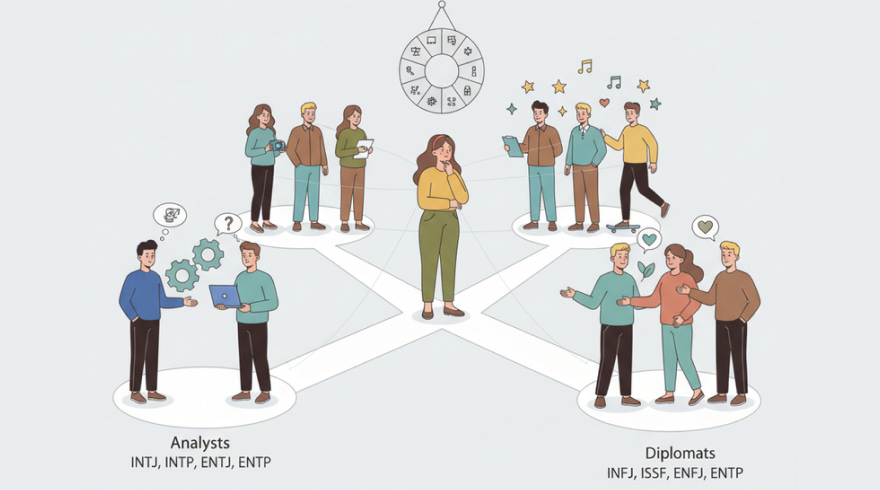
While no table can capture a person in full, a structured snapshot can make it easier to compare patterns and find starting points for development. The four preference pairs, energy focus, information style, decision approach, and lifestyle orientation, combine to form sixteen distinct code letters that express a typical rhythm in work and communication. This layout is most useful when you treat it as a prompt for reflection rather than a checklist to memorize.
| Type | Nickname | Work Style Snapshot | Communication Tip |
| ISTJ | Inspector | Methodical, duty-focused, reliable with details and timelines. | Lead with facts, outline processes, confirm expectations. |
| ISFJ | Protector | Supportive, service-driven, preserves standards and harmony. | Connect to people impact, show appreciation, be specific. |
| INFJ | Advisor | Vision-led, empathetic, seeks meaning and long-term coherence. | Share purpose, invite insights, allow quiet processing. |
| INTJ | Strategist | Systems thinker, future-oriented, optimizes for leverage. | Explain rationale, respect autonomy, focus on outcomes. |
| ISTP | Troubleshooter | Hands-on analyst, calm in crises, rapid practical fixes. | Keep it concise, show mechanics, offer flexibility. |
| ISFP | Composer | Values authenticity, crafts tangible quality, adapts gently. | Be genuine, avoid pressure, demonstrate respect. |
| INFP | Idealist | Purpose-driven, imaginative, aligns work with core values. | Start with “why,” acknowledge meaning, allow options. |
| INTP | Architect | Conceptual, curious, refines models and elegant theories. | Invite critique, discuss frameworks, minimize small talk. |
| ESTP | Activator | Action-oriented, persuasive, thrives on immediate feedback. | Be direct, show stakes, enable quick wins. |
| ESFP | Entertainer | Energetic collaborator, reads the room, creates momentum. | Keep it lively, focus on people, celebrate progress. |
| ENFP | Campaigner | Idea generator, connector, explores possibilities enthusiastically. | Brainstorm first, refine later, link to values. |
| ENTP | Inventor | Debates assumptions, prototypes, pushes creative edges. | Challenge playfully, avoid rigidity, welcome alternatives. |
| ESTJ | Executive | Organizes resources, enforces standards, drives delivery. | Be clear, time-bound, and outcome-focused. |
| ESFJ | Host | Community builder, consensus-oriented, maintains morale. | Show consideration, agree on roles, offer feedback kindly. |
| ENFJ | Mentor | People developer, orchestrates collaboration toward vision. | Share vision, listen actively, align on purpose. |
| ENTJ | Commander | Decisive strategist, scales systems, sets bold goals. | State objectives, present data, move to action. |
To apply this snapshot, start by noticing your energy after different tasks, then compare with the type descriptions as hypotheses to test. People management improves when you align responsibilities with natural strengths and provide support for stretch areas. In team charters and onboarding guides, writers sometimes use MBTI 16 personalities as a compact label for these patterns, yet the real progress happens when you ask colleagues what energizes them and how they prefer to make decisions.
Beyond team design, many practitioners like to revisit their report after big life events, new roles, or major skill-building programs. Change reveals where preferences flex and where they remain steady, offering clues about sustainable workflows. When you see a phrase like MBTI test 16 personalities detailed in a handbook, it usually signals a deeper walkthrough of subthemes, growth practices, and conflict strategies, resources that help translate a four-letter code into daily habits you can actually use.
How to Take the Test Well and Interpret Results Responsibly
Good results begin with good conditions: set aside quiet time, answer from preference rather than skill, and think about what you do naturally when stakes are neutral. If you struggle with “it depends,” imagine your ideal day without external pressure and choose the option that feels most authentic. For many learners, a convenient entry point is a free MBTI test online 16 personalities style assessment, which can spark reflection before you invest in a more comprehensive interpretation or coaching debrief.
- Answer for the long run: pick what fits most days, not an unusual week.
- Ignore role expectations: your job title is not your personality.
- Preferencies ≠ competencies: you can be great at skills outside your comfort zone.
- Retest rarely: look for patterns over time, not micro-changes week to week.
- Pair results with feedback: ask colleagues which parts resonate and why.
Interpreting your code is only step one; the real value comes from turning insights into experiments you can try this week. For example, if you prefer broad possibilities, set a checkpoint to converge on a decision; if you favor structure, schedule an unstructured ideation block. When browsing introductory resources, you might encounter the phrase MBTI test 16 personalities free in communities that share quick-start guides, but remember that the legitimacy of your insights scales with the quality of your reflection and the evidence you gather from your own behavior.
Common Pitfalls, Myths, and Best Practices
Misuse usually comes from treating type as a box instead of a compass, or from assuming preferences are immutable. A frequent misunderstanding is thinking that a type label predicts performance, when in truth it only hints at how someone might prefer to approach tasks. You can develop strengths across the spectrum by practicing outside your comfort zone and by pairing with teammates whose instincts complement your own. In discussion threads and course syllabi, the term 16 personality test MBTI sometimes surfaces as a catch-all, yet careful facilitators stress that ethical application avoids hiring decisions or gatekeeping based on a four-letter code.
- Avoid stereotyping: individuals vary widely within each type.
- Don’t weaponize results: never use type to shut down ideas or assign blame.
- Beware confirmation bias: look for disconfirming evidence in your behavior.
- Context matters: stress, culture, and incentives can shift visible behaviors.
- Keep it practical: translate insights into daily checklists and routines.
Best practice is simple: use the model as a shared language for clarity, not as a verdict. When offering feedback, ground your comments in observable behaviors and outcomes, and invite the other person to share what energizes them. Over time, teams that adopt this approach report faster decision cycles, fewer miscommunications, and more humane collaboration, because they move beyond guesswork to explicit agreements about how work gets done.
FAQ: Clear Answers to Popular Questions
Is this framework scientific or just popular?
It sits in a middle ground: popular because it is easy to understand and apply, and useful because it captures stable preference patterns that many people recognize in themselves. While it differs from clinical diagnostics, its practical value in coaching, communication, and self-development is well documented in organizational settings.
Can my type change over time?
Core preferences tend to be stable, but behavior is flexible and adapts to roles, skills, and context. People often report clearer results after life experiences help them distinguish natural comfort from learned competence, which can shift how they answer certain items.
Which assessment should I choose?
Start with a reputable questionnaire that explains its scoring and offers actionable guidance, then consider a debrief with a trained facilitator for depth. In community spaces, some people try a lighter MBTI quiz 16 personalities style assessment to begin reflecting, and later compare results with more comprehensive tools.
How should teams use the results?
Use them to craft working agreements: preferred communication channels, decision timelines, meeting formats, and feedback norms. The goal is to reduce friction by making invisible preferences visible and to balance strengths across project phases.
What if my result doesn’t feel accurate?
Treat it as a hypothesis and test it against real situations over a few weeks. Journal observations about energy, decision patterns, and stress triggers, then revisit the descriptions to adjust your self-understanding with better evidence.